ELECTRONIC TRIAL MASTER FILE (ETMF) SOFTWARE
eTMF software for clinical trials
oomnia eTMF software by Wemedoo is a digital workspace for storing, managing, and accessing trial master file documents inside one unified Clinical Research Information System (CRIS).
Unified data capture
How does oomnia support TMF clinical trials?
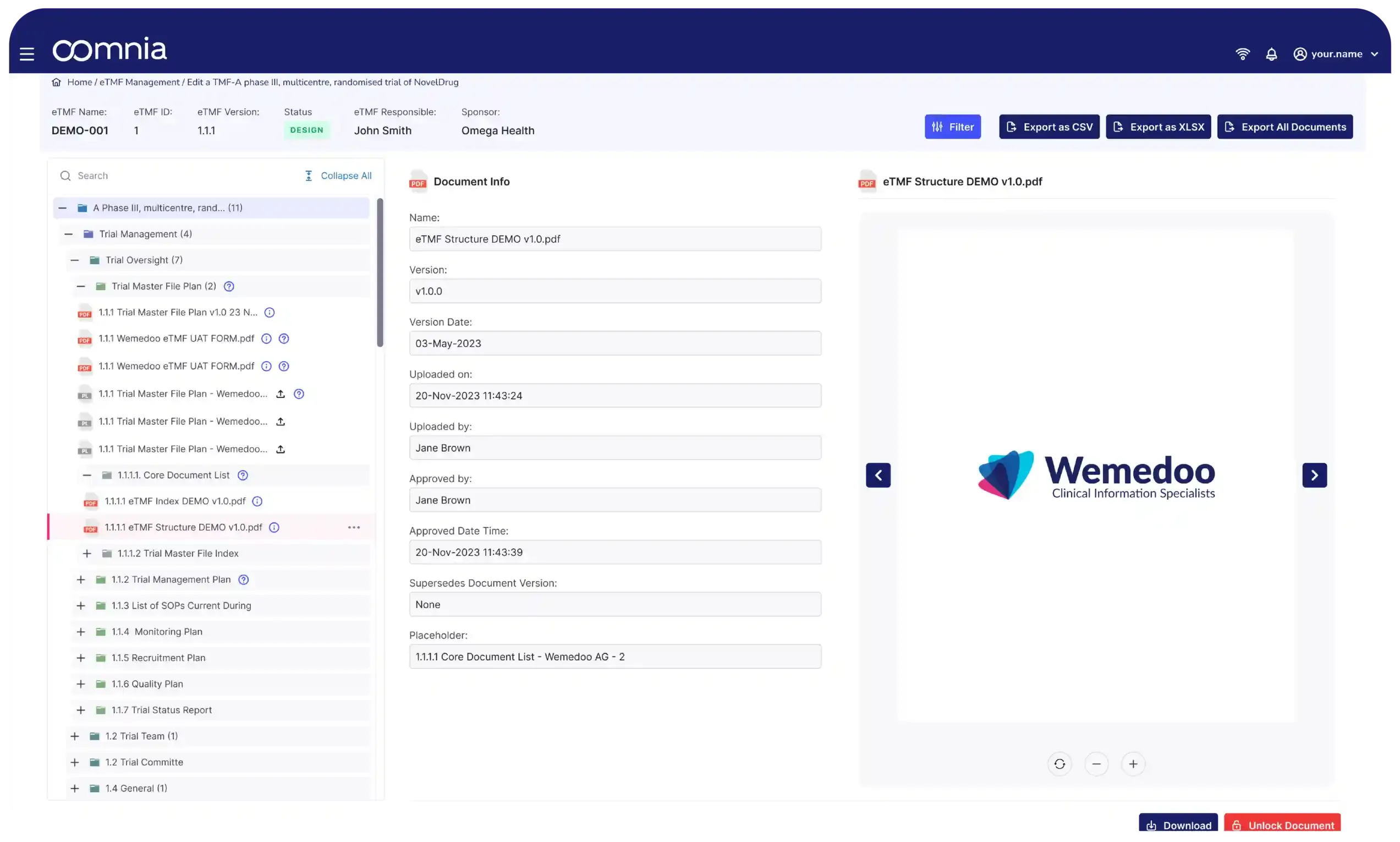
oomnia eTMF software is an electronic trial master file solution that centralizes the creation, storage, and control of essential study documents in a secure, role‑based environment. It allows authorized users to find, review, approve, and sign records from one place at any time.
oomnia eTMF software keeps documents structured and aligned with industry standards while enabling sponsors, CROs, and sites to work together in real time through a unified clinical research information system (CRIS).
CLINICAL DATA
What is oomnia eTMF system used for?
oomnia eTMF is designed to centralize and manage all essential trial documentation within a single, compliant environment.
oomnia eTMF software supports:
-
All trial documentation in one compliant, unified system
-
Remote collaboration and collection
-
Secure, role‑based access for sponsors, CROs, and sites
-
Real‑time visibility into document status and completeness
-
Audits and inspections with full version history and audit trails
-
Real-time streamlining of document review, approval, and e‑signatures
Key Capabilities
Key capabilities of oomnia eTMF software
| Aspect | Modular eClinical systems | Unified clinical trial software (oomnia) |
|---|---|---|
| System architecture | Separate eTMF system requiring integrations with EDC, CTMS, and site systems | eTMF within one unified clinical research information system (CRIS) |
| Document access | Files accessed through a standalone portal or shared drives | Centralized access within a connected study workspace for all stakeholders |
| Data & document availability | TMF updates rely on manual uploads or scheduled syncing from other systems | Real‑time document availability across all modules with no syncing required |
| TMF structure & metadata | Independent filing structure that must be manually aligned with study data | Shared metadata model automatically linked to study, site, and subject records |
| Collaboration & workflows | Limited workflow automation; approvals often handled outside the eTMF | Built‑in workflows for reviews, approvals, signature routing, and notifications |
| Integration with study database | Requires manual reconciliation and periodic alignment with EDC/CTMS | Always in sync with the unified study database, no reconciliation needed |
| Audit & traceability | Audit trails fragmented across systems and file locations | Complete, unified audit trail for every action and version change |
| Security & compliance | System‑specific permissions and isolated security controls | Encrypted data, role‑based access, unified CRIS‑wide compliance framework (GxP, 21 CFR Part 11, ICH‑GCP); Fully compliant with international and organizational standards |
| Time & Cost Efficiency | Manual system setup for each new study; Higher operational costs due to duplicated workflows and repeated configurations | Rapid study setup by reusing eTMF index, roles, and permissions; Lower operational costs due to unified processes and reusable structures |
Regulatory Readiness
Compliance and regulatory readiness
oomnia eTMF software is designed to support regulated clinical research environments and aligns with recognized international regulatory and industry standards governing electronic records, document management, and trial master file oversight.
GxP requirements
Supports GxP-aligned document management and quality practices across all study operations
21 CFR Part 11
Fully compatible with 21 CFR Part 11 electronic records and signature requirements
ICH E6 (R2/R3) GCP
Document workflows and TMF structures aligned with ICH E6 (R2/R3) Good Clinical Practice expectations for TMF management
How It Works
How oomnia eTMF works inside a unified clinical trial software?
Instead of functioning as a standalone tool, oomnia eTMF software is integrated within a unified Clinical Research Information System (CRIS). This means:
No disconnected systems for EDC, CTMS, or site collaboration
Fewer manual filing and reconciliation steps
Consistent document structures, metadata, and terminology across studies
Real‑time alignment between operational data and TMF content
Improved TMF completeness through automated, connected workflows
Who This Is For
Who oomnia eTMF management software is for?
oomnia eTMF is designed for:
CROs overseeing complex, multinational clinical trials
Teams transitioning away from fragmented TMF structures
Fast‑growing biotech and emerging pharma
Organizations seeking inspection readiness at all times
Clinical teams aiming to reduce manual document handling
Companies prioritizing real‑time visibility and oversight
Collaborative teams needing secure, role‑based access
The Platform
All clinical trial tools unified in one clinical trial platform
EDC software
Unified Electronic Data Capture system for compliant, real-time clinical data collection
CTMSCTMS software
Automated trial management solution designed to streamline study oversight
ECONSENTeConsent software
Electronic informed consent solution designed for seamless participant consent capture
EPROePRO software
Real-time electronic patient-reported outcomes solution for patient data entry
ECOAeCOA software
Capture patient-reported outcomes, clinician assessments, and study data in real time without paper workflows
RTSMRTSM software
Randomization and Trial Supply Management system that automates treatment allocation and blinding in real-time
ESOURCEeSource clinical trials
Electronic source system that captures original site data in real time, fully validated and without manual transcription
Get Started
It's time to unify your clinical data
Reduce fragmentation, cut reconciliation cycles, and gain clear, real‑time oversight across your studies.
Talk to our team