REAL-TIME CTMS SOFTWARE & CLINICAL TRIAL MANAGEMENT SYSTEM
CTMS software for clinical trials
oomnia CTMS software is an automated trial management solution designed to streamline study oversight within a fully unified clinical research information system (CRIS).
Unified data capture
How does oomnia support clinical trial management system workflows?
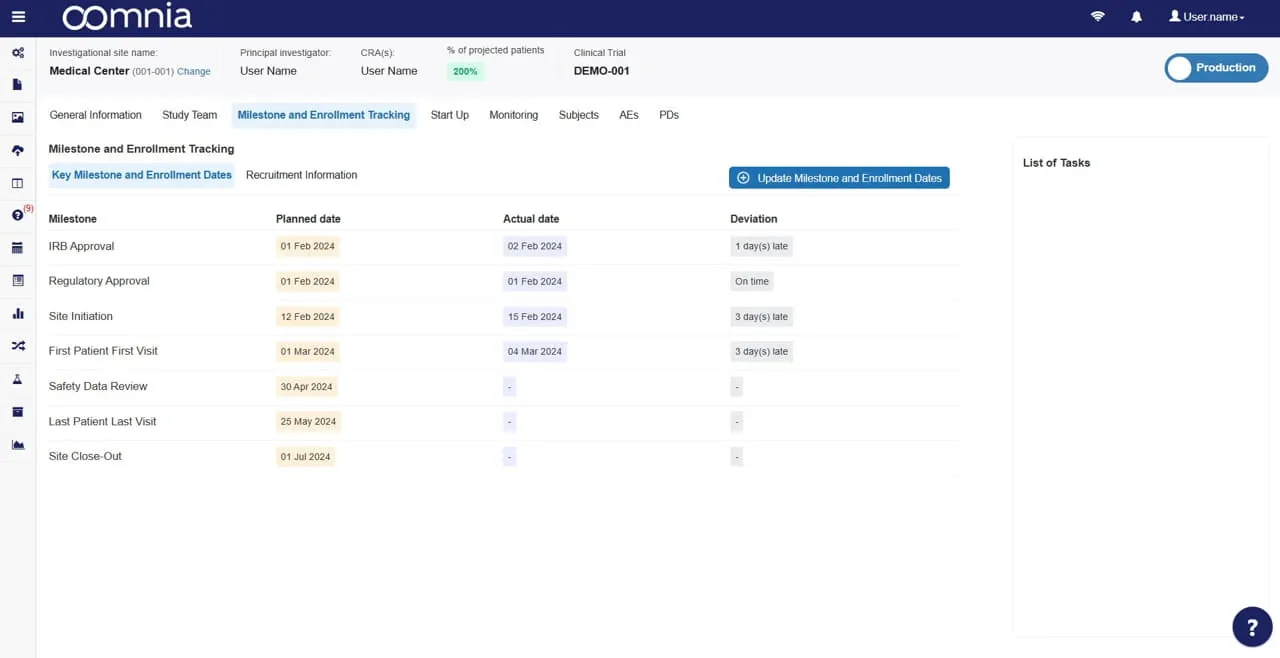
oomnia CTMS software is a clinical trial management solution designed to coordinate operational activities directly within a unified clinical research information system (CRIS). It supports end‑to‑end study oversight, including site management, visit tracking, milestone monitoring, task assignment, and resource planning, all in real time.
oomnia CTMS software eliminates manual tracking steps and redundant data entry, reducing administrative workload while giving teams immediate visibility into study progress, site performance, and operational timelines.
CLINICAL DATA
What is oomnia CTMS used for?
oomnia CTMS is designed to streamline the operational management of clinical trials by centralizing planning, tracking, and execution within a unified system.
oomnia CTMS software supports:
-
Centralized management of study milestones and timelines
-
Real‑time operational oversight across sites and study teams
-
Automatic integration with the unified study database
-
Automated alerts, task assignments, and workflow notifications
-
All operational and site‑level data in one unified system
-
Automated consistency checks to ensure data accuracy and alignment across modules
Key Capabilities
Key capabilities of oomnia CTMS software
| Aspect | Modular eClinical system | Unified clinical trial software (oomnia) |
|---|---|---|
| System architecture | Separate CTMS requiring integrations with EDC, eTMF, finance, and monitoring tools | CTMS operating directly inside the unified clinical research information system (CRIS), sharing one connected study environment |
| Monitoring visit management | Manual creation of monitoring visit reports in isolated tools; limited visibility into monitoring outcomes | Quick creation of monitoring visit reports with shared data, templates, and automatic linking to site records, action items, and timelines |
| Study visits tracking | Visit schedules tracked in spreadsheets or separate scheduling tools; status updates require manual entry | Real‑time study visit tracking connected to site calendars, monitoring plans, and operational workflows |
| Essential documentation tracking | Key operational documents stored across separate systems; version control and tracking require manual oversight | Centralized tracking of essential operational documents with shared metadata, versioning, and automatic linking to tasks and milestones |
| Enrollment and milestone tracking | Enrollment progress tracked manually in spreadsheets; milestones updated inconsistently | Automated milestone creation, real-time enrollment dashboards, and alerts for delays |
| Adverse event tracking | AE reporting managed in external safety systems | Central AE tracking with graphical reports and safety insights |
| Protocol deviation tracking | Deviations logged separately; difficult to link to actions | Central deviation log with linked action items, timelines, and safety data |
| Site staff management | Staff roles, responsibilities, and training records kept in isolated trackers or documents | Integrated site staff profiles with roles, responsibilities, training tracking, and connections to operational activities |
| Operational data model | Independent databases requiring manual reconciliation with EDC or eTMF | Shared operational data model aligned with patient, site, and regulatory data across CRIS |
| Financial management | Budgets, invoicing, and cost analysis handled in separate finance tools | Integrated budgeting, invoicing from monitoring activities, and real‑time cost tracking |
| Task & workflow automation | Manual reminders and coordination via email or spreadsheets | Automated task assignments, reminders, and workflow sequencing across monitoring, site actions, and study operations |
| Audit & traceability | Separate audit logs per tool; limited cross‑system traceability | Unified audit trail covering operational updates, monitoring activity, document changes, and timeline adjustments |
Regulatory Readiness
Compliance and validation
oomnia CTMS software is designed to support operational compliance throughout the clinical trial lifecycle, from study startup to close-out. The system framework aligns with recognized regulatory and industry standards governing clinical trial conduct, documentation, and oversight.
FDA 21 CFR Part 11
Fully compatible with electronic records and signature requirements
GDPR & HIPAA
Sensitive trial data protected in compliance with global data protection regulations
Role-based access control
Granular access management per user, site, and study
Complete audit trails
Detailed logs of all user actions ensuring system accountability
Electronic signatures
Secure e-signatures for delegation logs, visit reports, and compliance documentation
Data export & security
Secure export and sharing while maintaining full data integrity
How It Works
How oomnia CTMS system works inside a unified clinical trial software?
Unlike traditional CTMS systems that operate as stand‑alone operational tools, oomnia CTMS software functions as an integrated part of the unified clinical research information system (CRIS). This means:
No separate CTMS databases or disconnected operational trackers
No manual transfer of operational data into downstream systems
Shared data structures across operational, patient‑level, and regulatory modules
One unified audit trail covering operational updates, site actions, and system events
Fewer reconciliation steps between CTMS, EDC, eTMF, and monitoring workflows
Aligned operational terminology, forms, and workflows across study functions
Real‑time visibility into site performance, milestones, tasks, and visit activity
Who This Is For
Who oomnia CTMS software is for?
oomnia CTMS software is designed for:
Sponsors seeking stronger oversight and real‑time visibility into study operations across global trials
CROs managing multi‑site studies that require coordinated task management, monitoring, and milestone tracking
Research organizations transitioning away from spreadsheets or fragmented operational systems
Clinical operations teams aiming to reduce administrative workload through streamlined, automated workflows
Study managers who need consistent, inspection‑ready operational data across all trial activities
The Platform
All clinical trial tools unified in one clinical trial platform
EDC software
Unified Electronic Data Capture system for compliant, real-time clinical data collection
ETMFeTMF software
Digital workspace for storing, managing, and accessing trial master file documents
ECONSENTeConsent software
Electronic informed consent solution designed for seamless participant consent capture
EPROePRO software
Real-time electronic patient-reported outcomes solution for patient data entry
ECOAeCOA software
Capture patient-reported outcomes, clinician assessments, and study data in real time without paper workflows
RTSMRTSM software
Randomization and Trial Supply Management system that automates treatment allocation and blinding in real-time
ESOURCEeSource clinical trials
Electronic source system that captures original site data in real time, fully validated and without manual transcription
Get Started
What could unified clinical data unlock for you?
Cut reconciliation cycles, eliminate fragmentation, and gain real-time oversight across your trials.
Talk to our teamFrequently asked questions
What is CTMS software?
CTMS (Clinical Trial Management System) software is a solution used to plan, execute, and monitor clinical trials. Wemedoo's oomnia CTMS manages study planning, site management, enrollment tracking, milestone monitoring, risk management, and regulatory compliance from study initiation through completion.
What are the key features of oomnia CTMS software?
oomnia CTMS software includes study planning and setup tools, site selection and feasibility assessment, enrollment and milestone tracking, interactive study calendars, risk management dashboards, investigational product tracking, financial management, and comprehensive reporting, all within one unified clinical trial system.
How does oomnia CTMS differ from standalone CTMS solutions?
Unlike standalone CTMS solutions that require integrations with separate EDC, eTMF, and RTSM systems, oomnia CTMS is natively unified with all clinical trial tools. This means enrollment data from EDC, documents from eTMF, and randomization data from RTSM automatically flow into CTMS without manual data entry or reconciliation.
Can oomnia CTMS manage multi-site and global clinical trials?
Yes, oomnia CTMS is designed for multi-site and global trial management. It supports multiple countries, languages, and regulatory environments, with real-time oversight across all sites, centralized milestone tracking, and role-based access for sponsors, CROs, and site personnel.
What reporting capabilities does oomnia CTMS provide?
oomnia CTMS provides real-time reporting dashboards with customizable KPIs, enrollment metrics, site performance analytics, risk indicators, budget tracking, and milestone status. Reports can be generated automatically and shared with all stakeholders through the unified system.